
How pearls are graded
There are precise criteria for grading a cultured pearl, so much so that they are set out in an international table known to everyone in this particular trade. Grading is done by experts, who examine and assess every single pearl.
Whoever does this job needs very long experience of sorting pearls as well as a thorough knowledge of the market. The five grading factors that determine the quality of pearls are:
- Shape
- Size
- Colour
- Lustre
- Surface quality
Although it is always wise to rely on professionals in the trade for any valuation, it helps to know the basics so that you fully understand what you are buying.
Shape
The round pearl is the most sought after and therefore the most valuable. But the pearl is a natural product, subject to all the whims of Mother Nature, and not every shape she creates is perfect. The shape category includes: round, near-round, oval, drop, button, semi-baroque, baroque and circled.
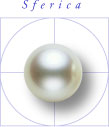
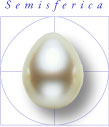
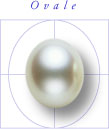
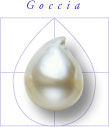
Round
A pearl is described as round when it is perfectly round or varies in diameter by no more than 2%. Round pearls are the rarest, and so command a higher price.
Near-round
These are round pearls whose diameter varies by between 2% and 5%. Because the chances of a perfectly round pearl are so small, the near-round is regarded as commercial quality, and is naturally valued below the round. Set in a piece of jewellery, a near-round pearl will most probably look round, so slight is the difference. That is why the grading has to be checked on loose pearls.
Oval
The shape is like that of an egg, but with the top the same as the bottom. A well-proportioned oval can be quite attractive.
Drop
A perfectly drop-shaped pearl is very hard to find. Those known as teardrops are much sought after; their perfection seems almost unnatural when you remember that they were grown by an oyster! A drop should be neither too elongated nor too flat at the base. A fine drop pearl is valued quite highly.
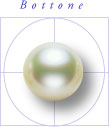
Button
These are flattened, button-like pearls. They are not in great demand, but in some pieces of jewellery they can be ideal, for example an earring with a pearl of large diameter: the button shape has a lower profile, and so looks better when worn.
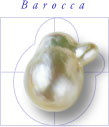
Baroque
This is the name for all pearls of irregular, indefinable shape; some may even suggest animals or fruit or anything else the imagination can conjure up. Some baroque pearls are enormous, even over 20 mm in diameter, and can be worth a good deal for their originality and because they are so hard to find. Most baroque pearls, however, are priced for what they are. Baroque pearls are very popular for imaginative jewellery designs, in which the artist can give free rein to his or her creativity. An equivalent term often used for them in Italian is perla scaramazza, which means essentially the same thing.
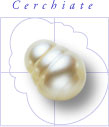
Circled
These can be any shape, from round to drop, but are marked out by more or less visible rings around them. They are among the least expensive pearls, yet they too have a charm of their own. In many cases they also show several shades of colour.
Size
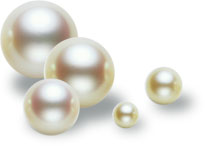
Sizing is a fundamental step in sorting. Pearls are divided not only by quality but also by size, in steps as small as a quarter of a millimetre.
Each type of pearl has its own basic characteristics when it comes to size.
Japanese pearls grown in Akoya oysters have a maximum diameter of 10 mm. Chinese pearls are sometimes larger, up to 13-14 mm. South Sea pearls, that is, Australian and Tahitian pearls, can in rare cases reach 18-20 mm in diameter.
Because it is really difficult for any oyster, of whatever kind, to grow a large pearl, the largest are generally the most prized.
Pearls are measured with a precision gauge that reads in hundredths of a millimetre.
Colour
There are two main categories: white and black.
Among the white pearls there are three categories: South Sea pearls, Japanese Akoya pearls and freshwater pearls. A pearl's colour is determined by the type of oyster that produces it: the pearl tends to take on the shades found on the lip of the shell in which it grows.
The nacreous substance a mollusc produces depends on the species it belongs to. Tahitian pearls come in a range of grey tones because that is characteristic of the oyster, and they are the only pearls in which these colours are natural.
Colour is not a fundamental factor in valuation, although some colours are more valuable than others; in the main it remains purely a matter of personal taste, often linked to skin, eye and hair colour. It is still worth describing the colours typical of the various types of pearl:
White South Sea pearls
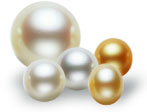
All pearls grown in Pinctada maxima, whether produced in Australia, Indonesia or the Philippines, have similar characteristics.
The predominant colours are silvery white, pinkish white, pale straw, lemon yellow or gold. Above all, the colour must be even over the whole surface of the pearl.
Black South Sea pearls
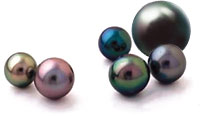
Black pearls come exclusively from French Polynesia. The colours of this variety range from greyish white to purplish black. The colour most prized in Tahiti is the one known as Peacock, after the bird.
This particular colour ranges from green to brilliant purple.
This splendid colour is not greatly appreciated in Europe, even though at source it is the most expensive.
Japanese Akoya pearls
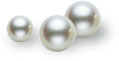
Japanese pearls occur naturally in various colours; they are bleached during washing, and those found on the market are pinkish white or bluish/greenish white.
What matters most is that a strand of pearls is uniform, with no variation in tone. In some cases white pearls are dyed grey or black with silver nitrate solutions, or treated with cobalt.
Freshwater pearls
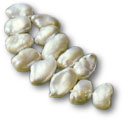
Freshwater pearls occur naturally in various colours: white, pink, orange, purple, mauve, wisteria and light brown. The variety is endless, but that can be seen as an attractive feature in a piece of fashion jewellery.
Freshwater pearls, too, are dyed black and grey.
Lustre
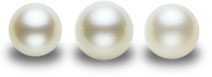
Lustre is a fundamental characteristic. A pearl of beautiful colour that does not reflect the light cannot be called a marvel; one whose lustre is so intense that you can see your own reflection in it certainly can.
If a pearl looks chalky, it plainly has no orient: its nacre has no lustre. No product or dye can make a dull pearl lustrous; only Mother Nature can do that.
Naturally, a fine lustrous pearl is priced far higher than a dull one.
Surface quality
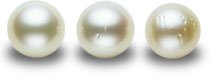
Surface quality means how clean the surface is. A fine, valuable pearl must be free of marks, growths and bumps; taken as a whole it must be smooth and even.
Every blemish, however small, lowers the market price. In some cases a pearl can be used despite its flaws if they can be hidden in the setting, in a ring for example; for commercial jewellery this is sometimes a welcome feature.
A flawless gem with an entirely clean, lustrous surface is so rare that the price rises considerably.